If there is one thing that unites our various hard working LGDs, it’s their ability and desire to work independently. Upon maturity, they ought to be able to work without direct, constant supervision and still make appropriate decisions. It is my firm belief that training ought to begin early, be consistent and fair, and utilize appropriate but heightening expectations throughout the maturation process. Many producers will find that they need a little help in terms of training tools, especially during the fairly long adolescent period. We’ll go over these tools more in depth in future posts, but here’s a quick overview for reference. ALL of these tools are meant to be used in conjunction with training and under some supervision.
1. Dangle Stick
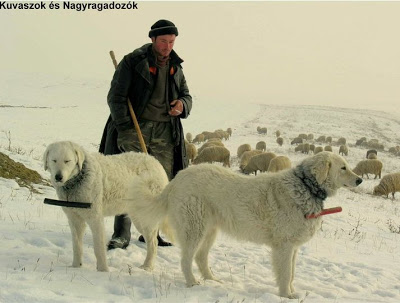
Young Kuvaszok with the Nagyragadozók Természetvédelmi Program
Dangle sticks are used the world over to impede young LGDs from chasing stock. They are a stick, metal or PVC tube that hang across the chest from a chain attached to the dog’s collar. When the dog begins to run, the rod bangs against their chest and makes the movement uncomfortable. Some producers have had success with graduating to a small dangling flap or hunting dog bell attached to the collar as a reminder to the LGD not to chase. As the desire to chase their charges should be short lived in LGDs (especially if caught early enough), these tools should only need to be used for a limited time.
2. Yoke

Our own Anneke modelling a PVC version

An innovative yoke using smaller pipe
A training yoke is a temporarily worn by LGDs who need to be prevented from escaping through fences and/or kept out of certain areas (a creep feeder, for example). It can be made from sticks, pieces of wood, or PVC/rubber pipes. The yoke should be inspected regularly for wear and tear and should allow for full expression by the wearer. This means that they should be able to lie down, eat, drink and otherwise live their life comfortably. It should be lightweight and is often attached to the regular, flat collar so that it cannot be easily removed.
